Back to all posts

Comparing summer and winter tires

Tires and their condition are among a vehicle's most critical safety factors. They directly influence grip, braking distance, and driving stability. Since weather and road conditions change significantly throughout the year, your tires must be suited to them. While winter tires are mandatory in many countries under certain conditions, choosing the right tire is essential for driving safety regardless of legal requirements.

Winter

Table of Contents

Summer tires for warm temperatures

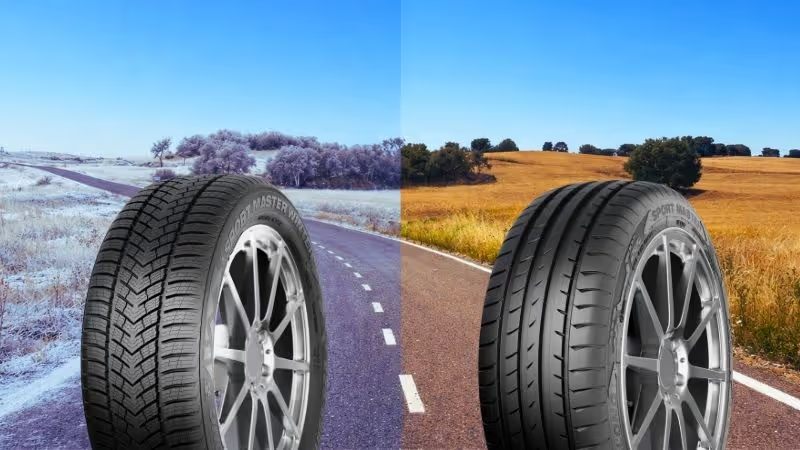
Summer tires are designed for temperatures above seven degrees Celsius. Their rubber compound remains stable in this temperature range, and the tread is optimized for dry and wet roads. The result is shorter braking distances, high cornering stability, and precise steering. Additionally, summer tires roll more efficiently, contributing to lower fuel consumption. However, they lose significant grip and safety in winter conditions.

Winter tires for cold and snow

When temperatures consistently drop below seven degrees Celsius, winter tires are the right choice. Their special rubber compound remains flexible in the cold, ensuring better road contact. The deeper tread and sipes provide more traction on snow, ice, and slush, shortening braking distances on slick or cold, wet roads. These features make winter tires unsuitable for summer, as they wear out faster and lose driving precision.

The right time to change tires

The "O-to-O" rule—from October to Easter—serves as a proven guideline, supplemented by the seven-degree Celsius temperature mark. In Germany, temperatures are below this threshold for about 185 days a year. Driving on summer tires during this time risks longer braking distances and reduced vehicle control.

Safety through seasonal tires

Tests clearly show that winter tires have distinct disadvantages in summer conditions, and summer tires have them in winter. Using the right tires for the season is not a matter of comfort, but a fundamental requirement for safe driving. Changing them on time not only increases safety but also benefits from better mileage and efficient operation.

More posts

View all posts
Tire purchase

Buying tires: What really matters when choosing new tires

Buying new tires significantly impacts a vehicle's safety, handling, and efficiency. Tires maintain contact with the road and determine how precisely a car steers, brakes, or accelerates. When buying tires, several factors should be considered: in addition to manufacturer specifications, personal driving style, budget, and regional weather conditions are key decision-making criteria.

Buying tires: What really matters when choosing new tires
Summer

This is why the seasonal tire change is important

Summer tires in winter: Driving on summer tires during winter poses a major safety risk and is not recommended. When temperatures consistently drop into the low single digits, summer tires lose significant grip. Frost, snow, or ice further exacerbate the problem. Changing from summer to winter tires in a timely manner is therefore crucial for driving safety, braking distance, and vehicle control. Summer tires are designed for warm weather and quickly reach their physical limits in winter road conditions.

This is why the seasonal tire change is important
Winter

Buying winter tires – safety and control in winter road conditions

Winter tires are a smart investment for the cold season. Specifically designed for low temperatures, snow, slush, and wet roads, they play a crucial role in driving safety. Buying winter tires ensures better traction, shorter braking distances, and more stable handling in winter. Compared to summer tires, winter tires feature a significantly deeper tread and numerous sipes. These interlock optimally with snow and slush, ensuring that contact with the road is maintained.

Buying winter tires – safety and control in winter road conditions

Tire search

Find the perfect tire now

The Linglong Tire Manager quickly and easily finds the right tire for your vehicle – whether you’re looking for summer, winter, or all-season tires.

Roter Volkswagen SUV fährt auf einer Straße mit unscharfem Hintergrund aus Bäumen und Gebäuden.
Reihe von neuen Autoreifen mit Aufklebern, die auf einem Metallregal im Lager stehen.
Frau sitzt lächelnd im Fahrersitz eines Autos und betrachtet ein Klemmbrett, das ihr von einer Person außerhalb des Fahrzeugs gezeigt wird.